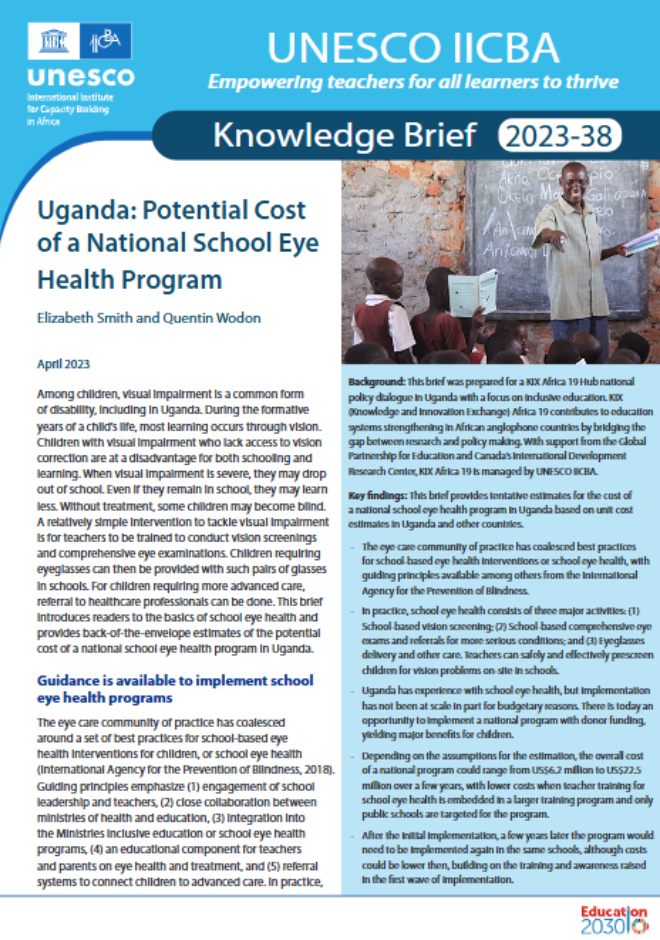
This brief provides tentative estimates for the cost of a national school eye health program in Uganda based on unit cost estimates in Uganda and other countries.
All Resources
Showing 251 - 260 of 488
Results are ordered by date, with most recent published resources shown first.
Use the other filters to customize your search.
Results are ordered by date, with most recent published resources shown first.
Use the other filters to customize your search.
These Wheelchair provision guidelines aim to support improved access to appropriate wheelchairs, for all those in need, including children, older persons, people with mobility disabilities, and those with chronic health conditions. They are relevant for all countries and apply to all wheelchair users and types of wheelchairs. They emphasize that the best outcomes in…
These Wheelchair provision guidelines aim to support improved access to appropriate wheelchairs, for all those in need, including children, older persons, people with mobility disabilities, and those with chronic health conditions. They are relevant for all countries and apply to all wheelchair users and types of wheelchairs. They emphasize that the best outcomes in…
These Wheelchair provision guidelines aim to support improved access to appropriate wheelchairs, for all those in need, including children, older persons, people with mobility disabilities, and those with chronic health conditions. They are relevant for all countries and apply to all wheelchair users and types of wheelchairs. They emphasize that the best outcomes in…
A nationwide population-based household survey was conducted from 7 December 2021 to 27 December 2021 using the WHO rapid Assistive Technology Assessment (rATA)
questionnaire. This report shares the results of this survey.
The collection of routine data for eye and ear care from health facility reporting underpins health related decision-making in health policy, management and clinical care.
This guidance document on the analysis and use of routine health information systems aims to support the integration of eye and ear care into the routine health facility reporting. It assists the…
This guidance document supports the monitoring of rehabilitation services, programme management and system-level decision making, through a proposed set of standard indicators;
considerations for their analysis and use are also presented (referred to hereafter as the “analysis framework”)
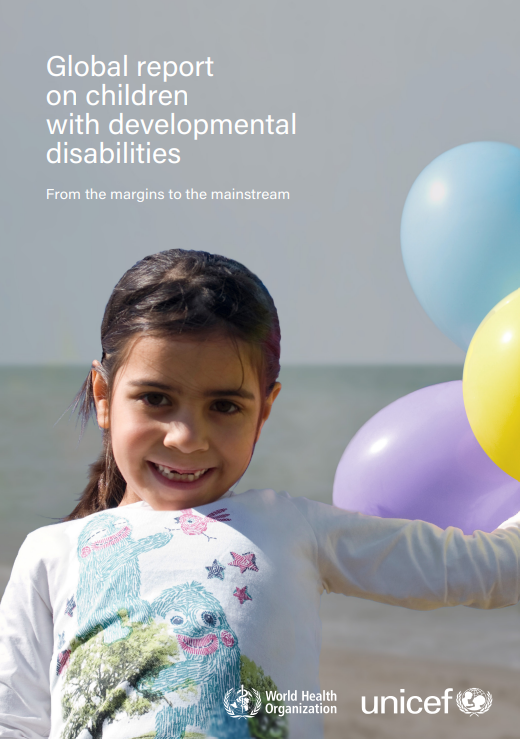
The aim of this global report is to increase awareness on the significance of investing in intersectoral approaches to promoting health, well-being and participation and access to quality care for persons with developmental disabilities from a public health and social justice perspective. It also provides a framework for action to accelerate changes in sociocultural,…
This historic resolution, the first WHO assembly resolution dedicated to rehabilitation, calls for embedding rehabilitation services across health systems as part of universal health coverage. It urges Member States and WHO to expand workforce, integrate rehabilitation into primary care, strengthen financing and infrastructure, and better coordinate services to meet…
This research paper examines assistive technology (AT) provision in humanitarian contexts, specifically in Bangladesh and Jordan. Through interviews and qualitative analysis framed by WHO's 5 Ps (Products, People, Provision, Place, Policy), the study identifies key gaps and challenges, highlighting the need for systematic integration of AT into humanitarian…