This publication summarizes the situation of the assistive technology system in Georgia as of August 2021, and the findings of a household survey on assistive technology conducted in March 2021. It describes the current resources, needs, gaps and opportunities in the area of assistive technology in Georgia, and provides recommendations on how to strengthen the…
All Resources
Showing 181 - 190 of 460
Results are ordered by date, with most recent published resources shown first.
Use the other filters to customize your search.
Results are ordered by date, with most recent published resources shown first.
Use the other filters to customize your search.
Many of the common causes of ear diseases and hearing loss, for example ear infections or loud sounds and noise, can be prevented. Timely treatment and rehabilitation can benefit all people with ear diseases and hearing loss. Health workers, general practitioners, family doctors, and doctors working at primary level are often the first point of contact for people to…
The Trainer’s handbook accompanies the Primary ear and hearing care training manual. This handbook is intended for use by those involved in training health
workers or in coordinating programmes for delivering ear and hearing care.
The Annexsres accompany the Primary ear and hearing care training manual. This handbook is intended for use by those involved in training health workers or in coordinating programmes for delivering ear and hearing care.
The Guide for Rehabilitation Workforce Evaluation (GROWE) comprises a suite of resources that can be applied in countries to provide information to support planning and advocacy at the national or subnational level. GROWE applies a labour market and competency analysis approach to help stakeholders in countries not only capture the state of the rehabilitation…
This document contains the second edition of the WHO Rehabilitation Indicator Menu (RIM), which is a tool accompanying the Framework for Rehabilitation Monitoring and Evaluation (FRAME) guidance. The FRAME guidance is part of the WHO Rehabilitation in health systems – guide for action .
The purpose of the workshop that this report covers was to disseminate amongst lead national stakeholders, key findings and recommendations from the Global report on assistive technology, and PAHO/WHO and UNICEF resources to support national implementation; for countries to share their experiences and lessons learned in strengthening access to assistive technology.
This report summarizes the outcomes of the regional rehabilitation meeting held in Addis Ababa, Ethiopia, from 21–23 November 2023. It highlights critical issues and opportunities in rehabilitation services across African countries, noting substantial unmet needs, insufficient prioritization, and funding gaps in rehabilitation care, especially at Primary Health Care…
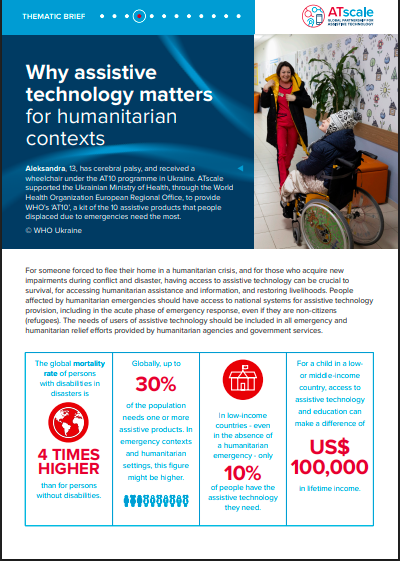
This report presents the AT10 project in Ukraine with aims to inform future implementation by presenting the lessons learned from the first phase of this project (2022–2023)
Templates to help you record and review low-risk and under advice assistive technology (AT) needs. Support reablement, client safety, and compliance with quality standards.